
“The stone decides”
- Freja Niemann LundrupMeet Freja Niemann Lundrup - sculptor, equilibrist and master of minerals. Here, the name is chiselled into granite and engraved into your soul through breathtaking empirical works.
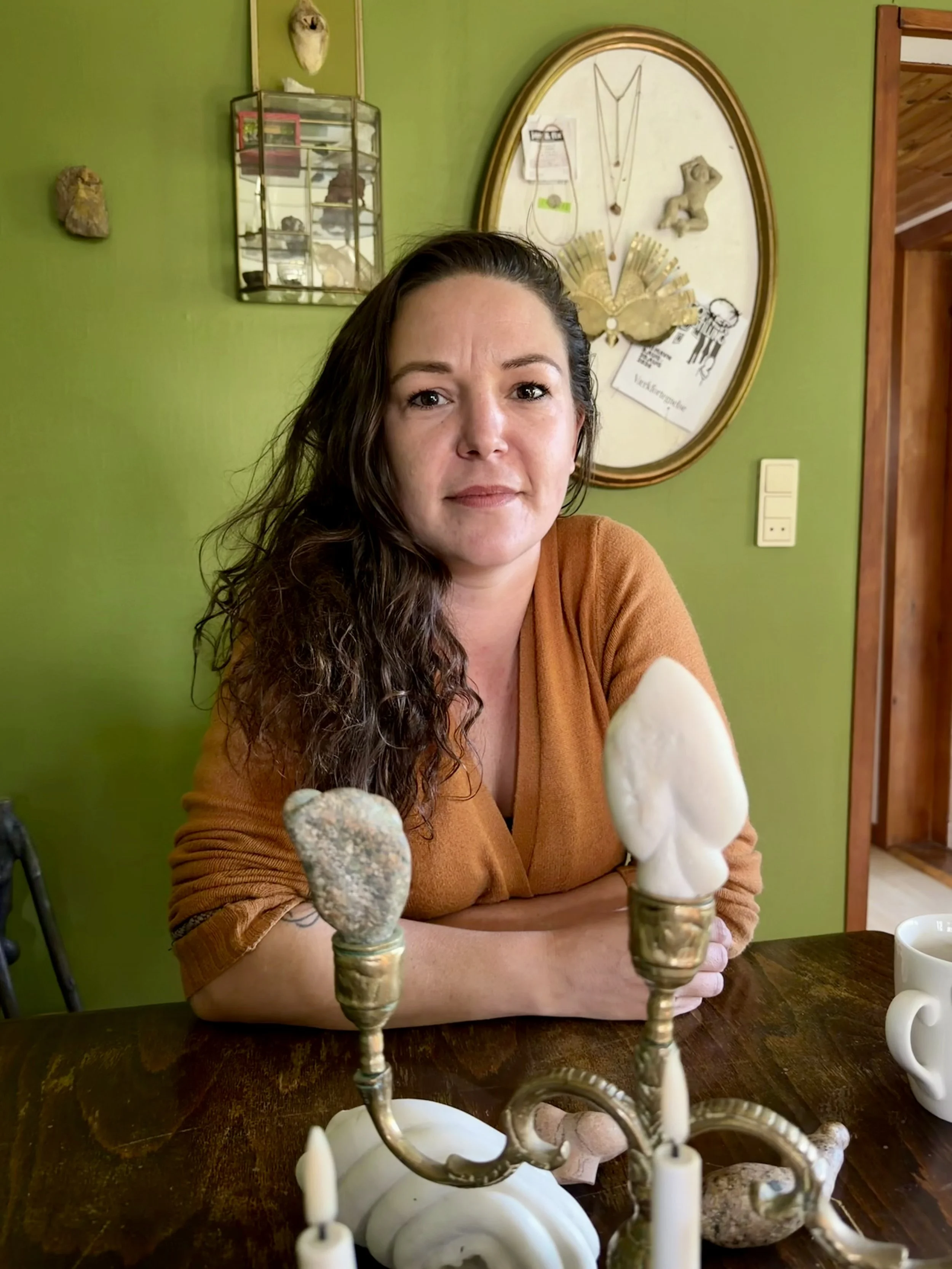
artSIStra interview // Henriette Hellstern // Sep. 25. 2026 // Svendborg // Denmark
She thrives in the dust. The grinding machine is working, the respirator protects her, the hearing protection shuts out the world. Small stone flakes fly through the air, and the dust settles over her like a second skin; this is where she belongs.
An alternative route
The autumn sun hangs low over the landscape and hits my face as I move along the strait, past the fields and into the forests of South Funen. The road becomes narrower, the landscape denser, and somewhere between earth, fir trees and tall grass, the GPS begins to lose its authority. It feels appropriate.
“Straight down the main road, onto the gravel road between two fields and to the left, where the gravel road splits.” That is what the text message I have just received says. The navigation application shows something entirely different, but I ignore it and trust the message, moving along a narrow path that indeed splits, past a mailbox standing wide open and revealing a couple of old newspapers, continuing around the bend and towards the small brown woodland house and workshop.
I have been looking forward to delving into Freja Niemann Lundrup’s practice. We first met more than 15 years ago, and even then there was something about her artistic practice that stayed with me. An uncompromising understanding of the necessity of art. A rawness. A particular kind of seriousness. And an artistic language that only seems possible when you yourself have something at stake.
Now we are standing in the middle of the forest. Here, hardness meets softness.
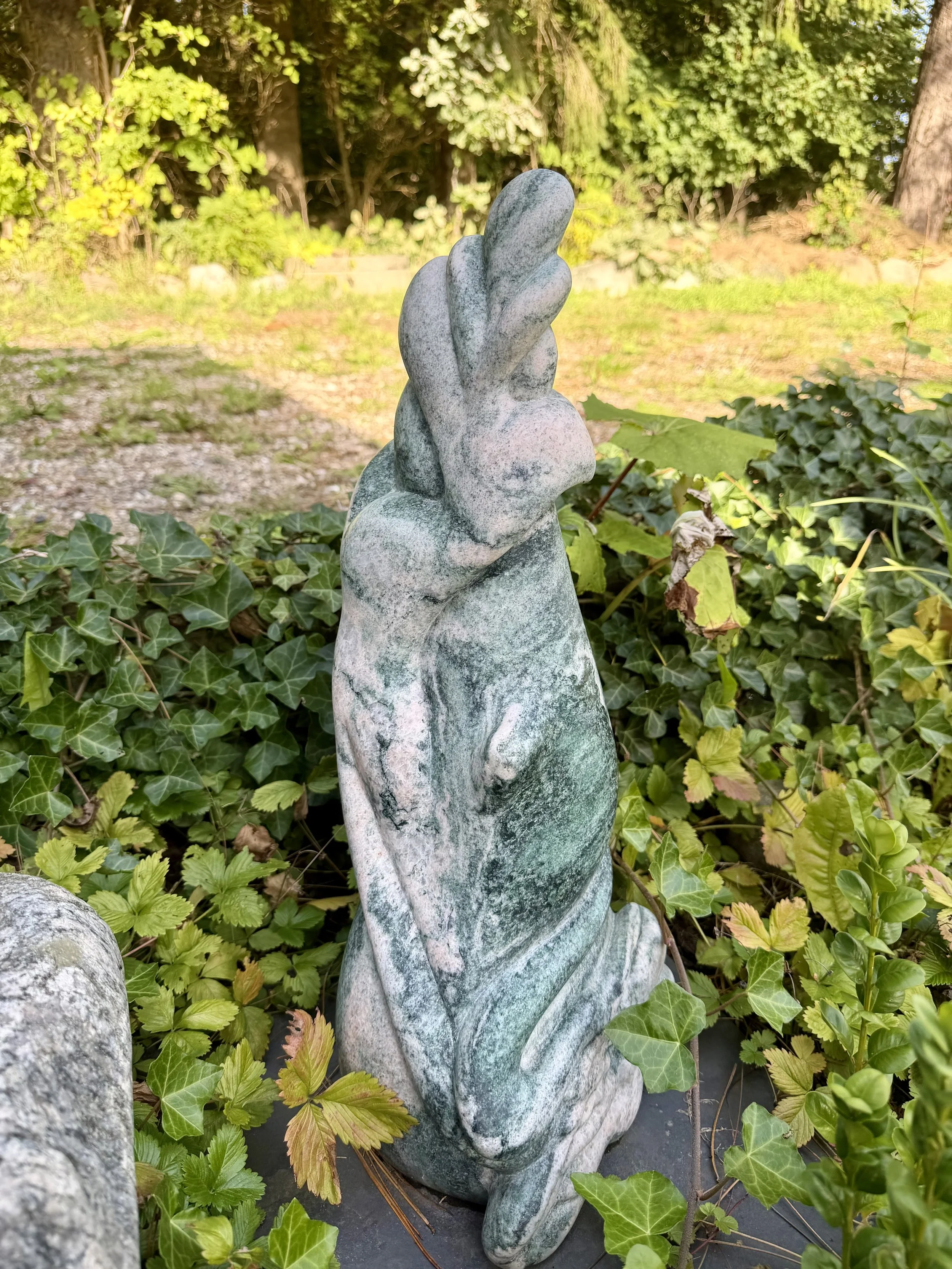
Artwork by Freja Niemann LundrupThe material before and after
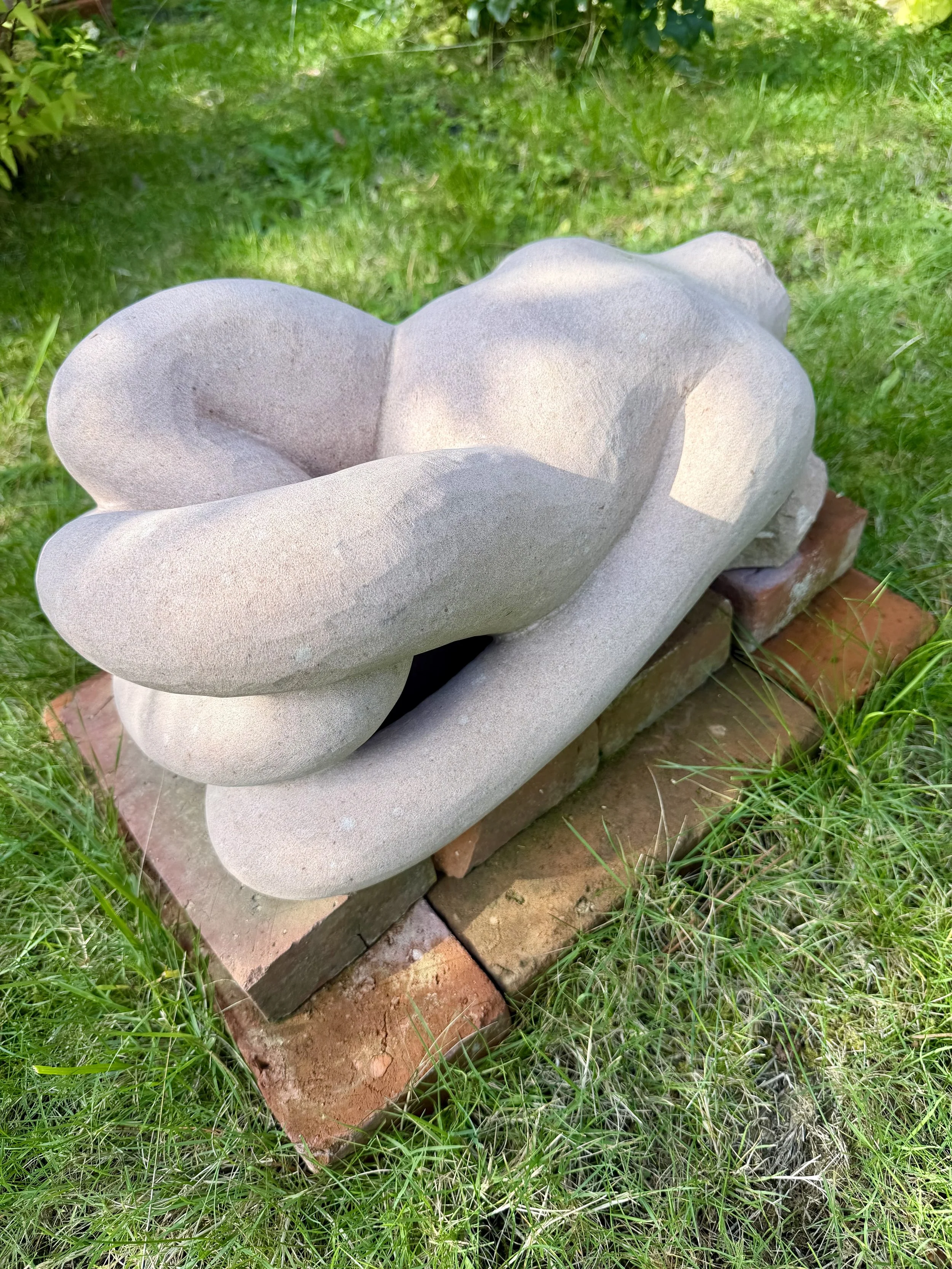
“The body of the stone is a mirror of the human body,” says Lundrup and adds, “I reveal a form that already exists.” The spruce trees form a ceiling with their orange-brown autumn attire as we move through the grass and her works in limestone, granite, rapakivi, fibre concrete and gneiss. Some figures are lying down. Others stand on small plinths, hang from the ceiling of the house or are situated on floors and walls.
They are quiet, but not silent. I get the sense that they are watching me as I watch them. And all the while they return to the same things: anatomy, cycle, nature. My own body. The weathered body, the body I rarely forget, my shell. “I use discarded stones,” Lundrup tells me enthusiastically. Sustainability is not an addition to her practice, but embedded within it. She works with what already exists. Materials that have lived a life before ending up in her hands.
Cracks mean collaboration
“Stones carry a history.” So do people. Lundrup can now celebrate two years without drugs. Once, drugs were a kind of toxic friend. A friend that could put a lid on the darkness, soften the shadows and make the unbearable just a little more bearable. But the darkness did not disappear. Her childhood was marked by abuse and neglect, and perhaps that is precisely why the branching forms become so significant in her art. Because where something has ended, something else can begin. While working on her graduation piece from the Jutland Art Academy, she found a way to process her traumas. Not by hiding them, but by working her way into them.
“Cracks invite collaboration; I take control.” It is a sentence that lingers. Fractures are no longer merely a sign of something broken, but rather an invitation. Sometimes Lundrup works on three pieces at once, she tells me. She says it with a seriousness that makes it impossible to believe that a stone is just a stone.
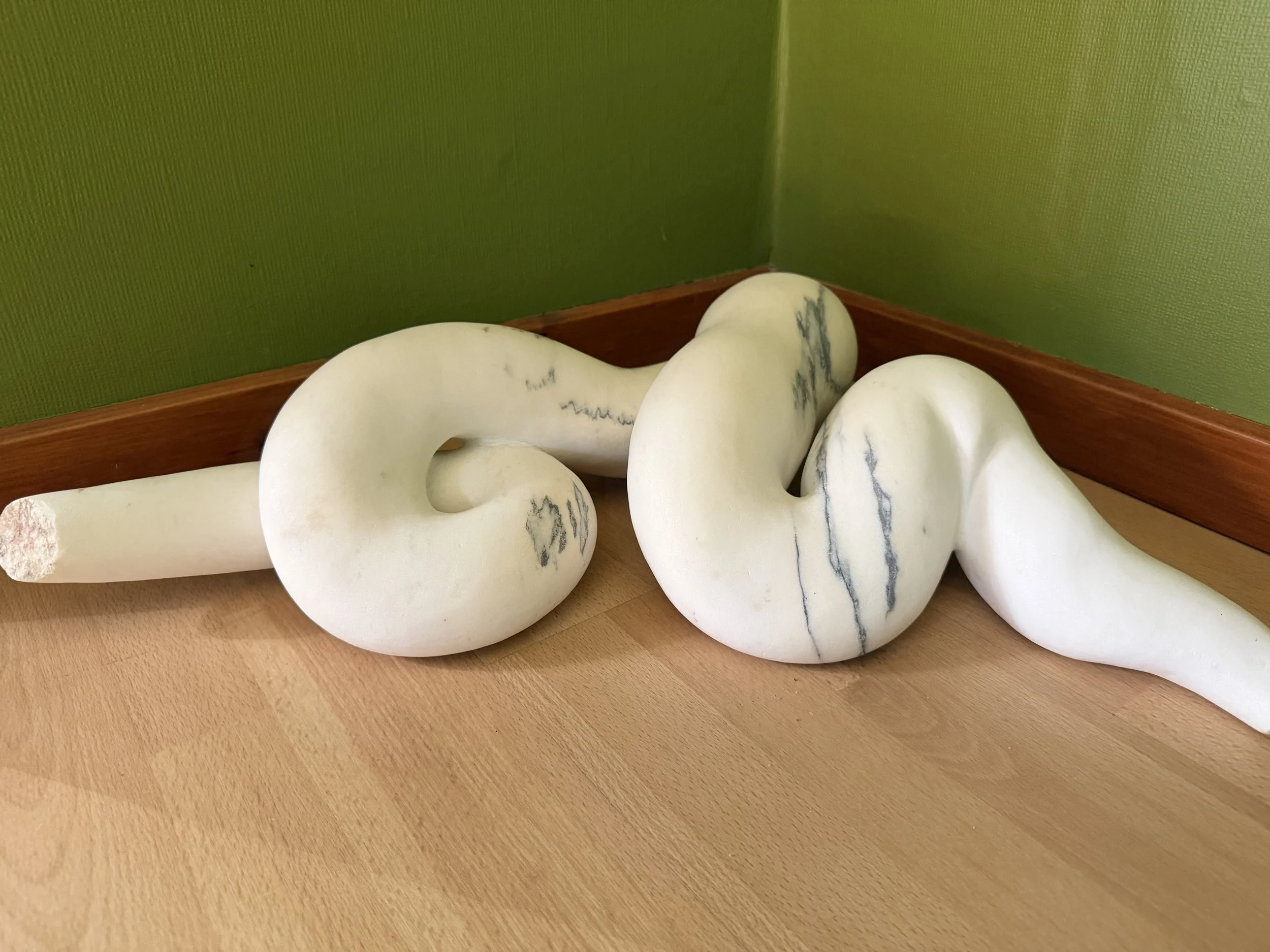
Artwork by Freja Niemann LundrupHome is where the stone flakes fly
Her years of study in Bremen were decisive for her relationship with the material. Here she learned to insist on quality, not to compromise and to aim high. Not because ambition in itself is interesting, but because the material, the narrative and the ability demand it. And Lundrup does not work with easy materials. She thrives in the dust. The grinding machine is working, the respirator protects her, the hearing protection shuts out the world. Small stone flakes fly through the air, and the dust settles over her like a second skin; this is where she belongs.
Every now and then, however, she has to call her mother. She did so, among other times, when Femur was being created. The thigh bone. The largest bone in the human body. The form had to be found, and her mother’s old school skeleton therefore had to be photographed so that the bone could fall properly into place.
To remove is to see
When Lundrup looks at the surface of a stone, she already sees the result. “I only remove, I never add,” she says and laughs. It sounds simple. Almost self-evident. But standing in front of me is a person whose own shell has been necessary. A resilient surface that has protected something porous underneath. A protective suit that may once have been a prerequisite for just being in the world, but which can now slowly be set aside.
She no longer hides. She insists that we look. And listen. She points out that we must be able to contain and show more than the pretty surface and the idealised image. Because life is not all sunshine and rainbows, bourgeois trivialities and clapping on the backbeat. Life is multifaceted, for better and for worse, but it can also be unbearable.
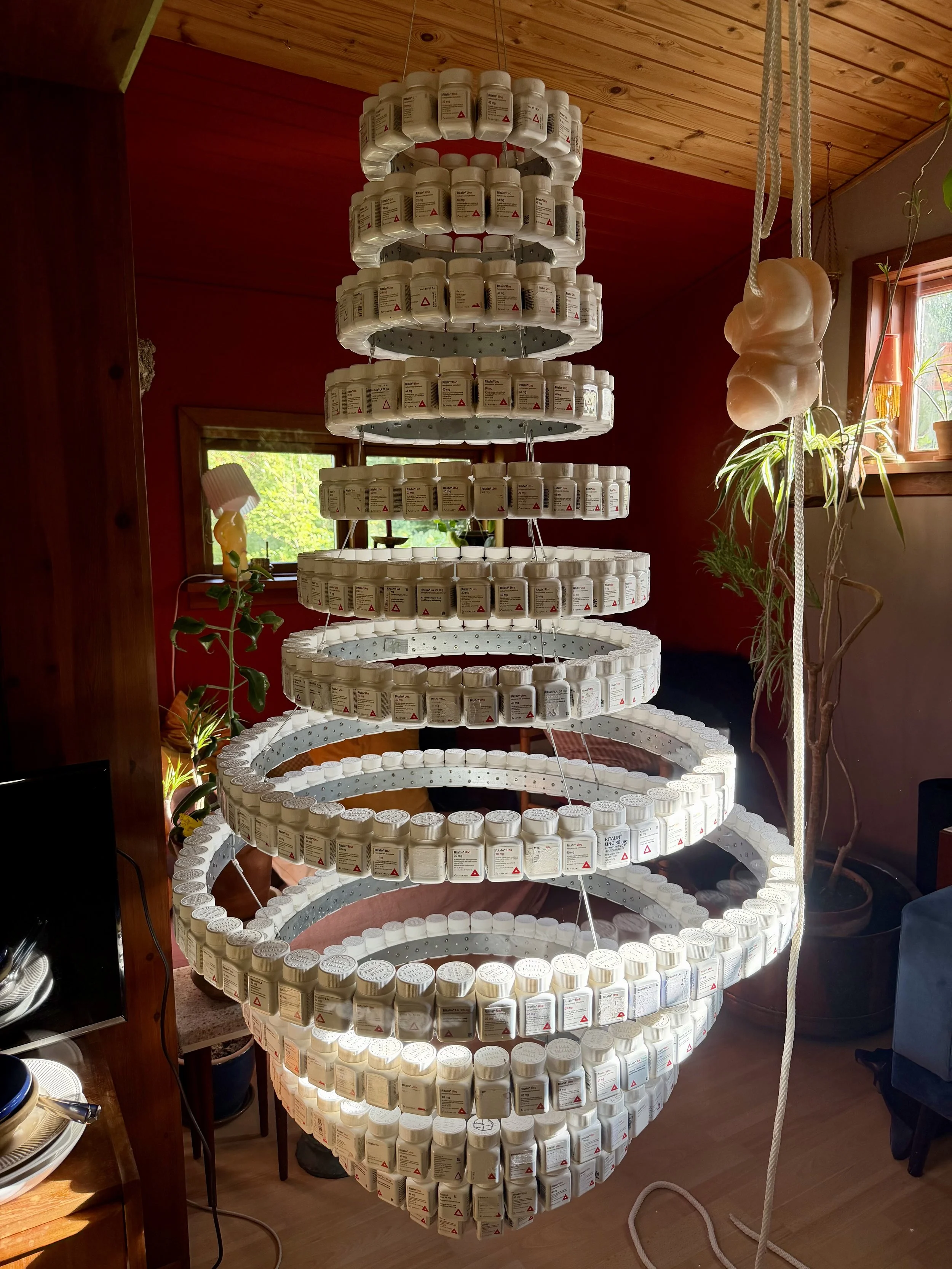
Artwork by Freja Niemann LundrupHag stones, pill boxes and coffee
We immerse ourselves in the 7.4 metres of hag stones she has patiently collected and hung up in a self-made copper chain, before having a cup of coffee in the company of a gigantic chandelier created from the pill boxes from her former addiction. The seconds work alongside her. Transience works alongside her. Even death seems to be present.
We talk about how little time we actually have. A split second on a planet that was here long before us, and which will hopefully continue long after. We agree to make the most of the moment. And then we bend down. The afternoon rays of sunlight have just penetrated a crack in a piece of rapakivi stone. A small piece of light, caught in something that is millions of years old.
“There is so much being released in the stone that I cannot help but follow it,” she says. “The stone decides.” Perhaps this is where Lundrup’s artistic practice truly becomes interesting. It has its own history, its own body.
Patience is a virtue
Lundrup is not Sisyphus, condemned to push the same stone up the same mountain forever, only to watch it roll back down and begin again. She is on her way up as one of the country’s most interesting sculptors, and she takes the stone with her. For although the foundation that was cast for the artist as a little girl was crooked, the adult woman creates art that will reach far into the future and serve as a landmark for generations to come.
A reminder that even the deepest-buried minerals, waiting for millions of years beneath the earth without knowing what will become of them, can one day reach the light if they are patient and brave enough.
Artwork by Freja Niemann Lundrup