
“The body remembers”
- Lene Winther
A Discovery of Substance.
Meet contemporary artist Lene Winther and step into sculptural reflections,
where the soul finds a nest and is gently rocked into freedom.
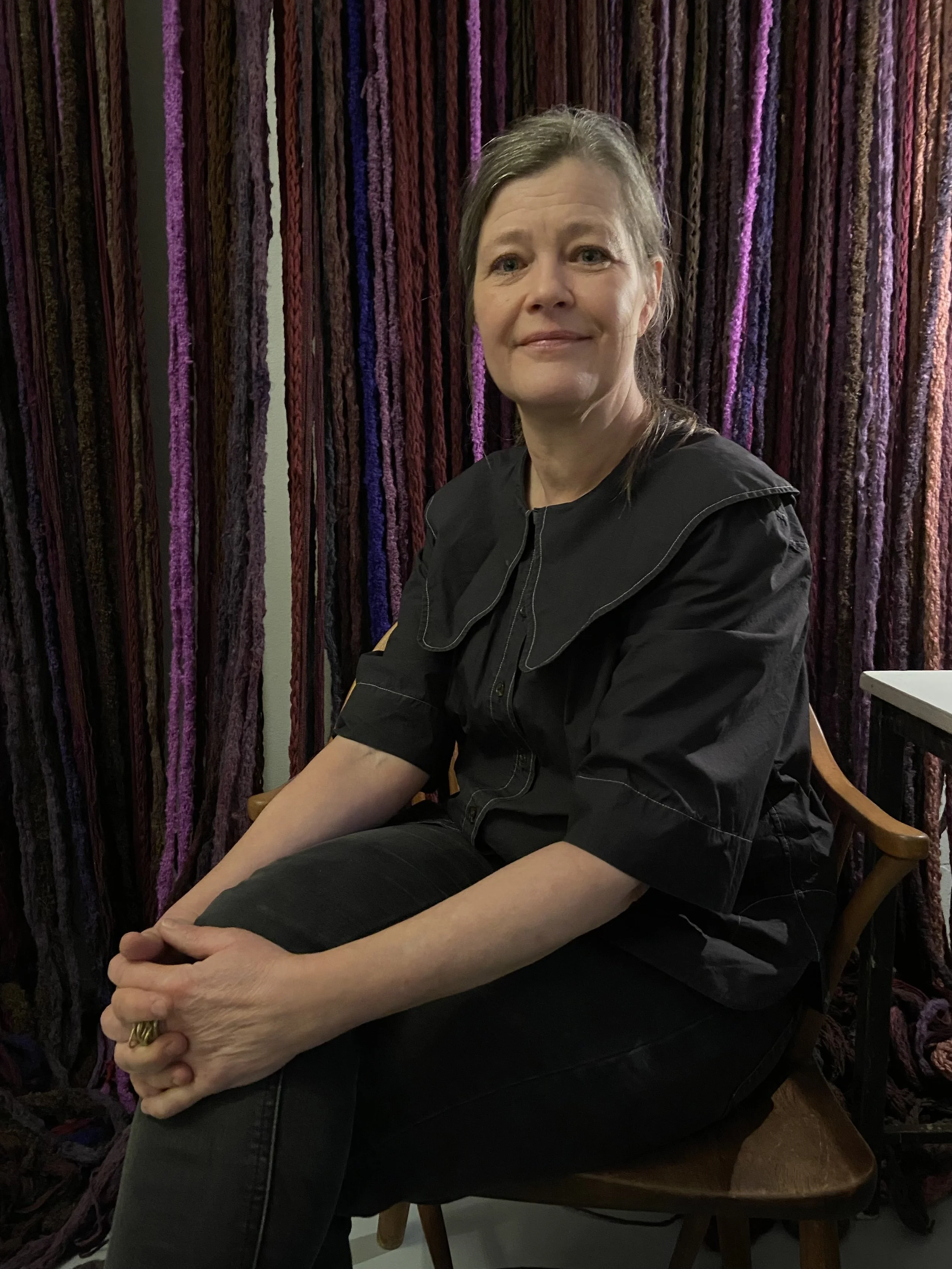
What would we do without artists like Winther, an artist who not only masters the craft, but insists on the difficult conversations and shares them with an energy carried by an unusually reflective, empathetic way of being in the world?
artSIStra interview // Henriette Hellstern // Jan. 23. 2026 // Rødovre // Denmark
An Enriching Find
“You have to see my kiln,” Winther says, almost ceremoniously, as we cross the front garden toward an annex. A 150-liter ceramic kiln rises like a monument, flanked by buckets of glaze and a spray booth. This is where the magic begins, I think to myself. The tour continues through the house and down into the basement, where the art practice has expanded so thoroughly that the previously planned man cave had to yield. Rightfully so.
As I brush slush from my shoes on the steps, a dog’s bark breaks the cold winter air. “It’s just Loui,” Lene Winther says with a warm, open smile as she lets me into the white brick villa in Rødovre. Loui, a small cream-colored Bichon Frisé with a canine tooth insistently peeking out, settles once I have respectfully greeted the true head of the household.
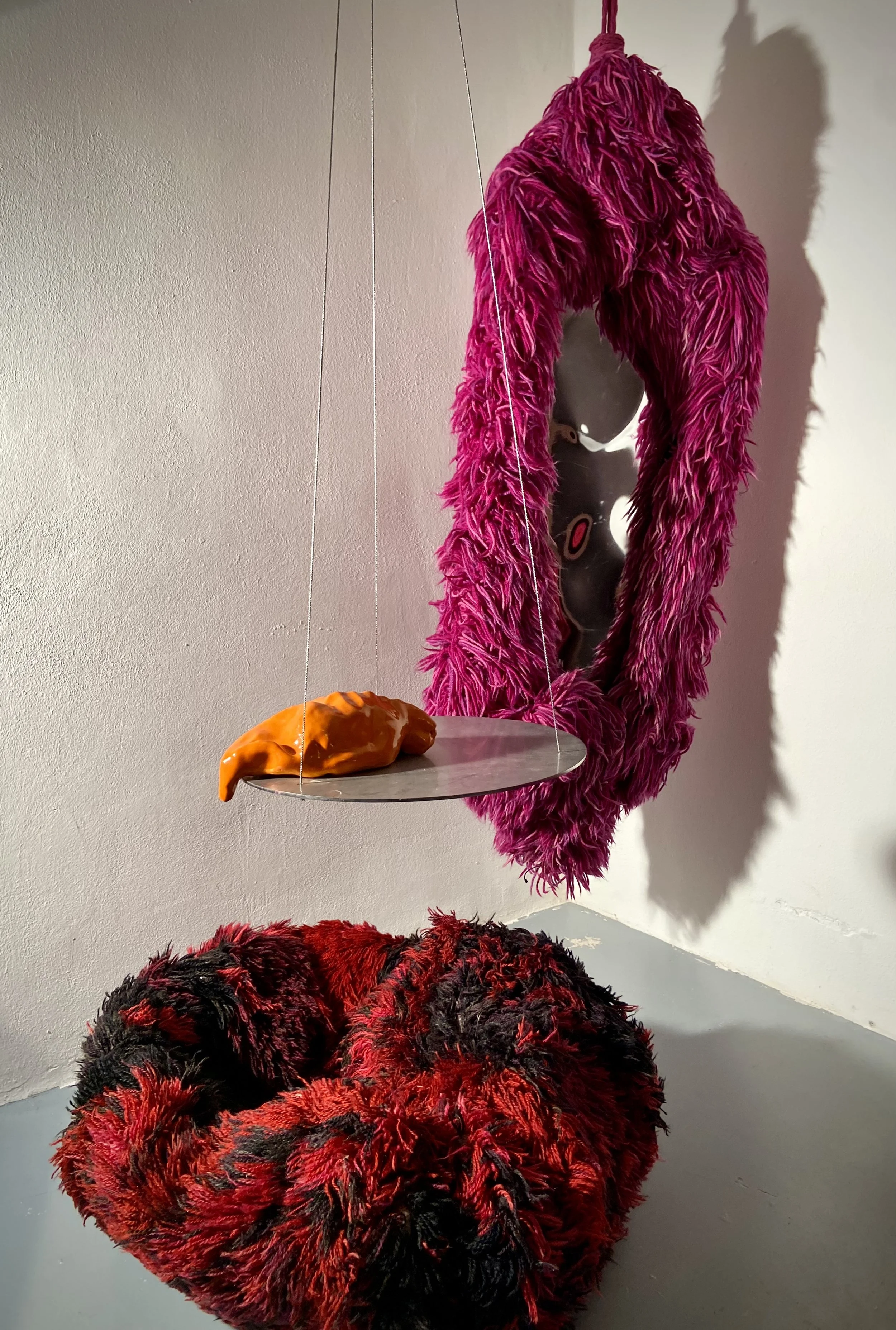
Pareidolia and various objects, rugs, mirrors, ceramic, wire, metal, 2026
Winther is an artist who requires space. She manages intensely along several paths at once, both in a sculptural vein and in an installation-based direction, where composite, variable elements are staged. I am met by a floating pink vagina, swathed in rya rugs, with a mirror embedded in its interior. “Found objects,” she affirms me.
The piece rotates slowly, mirroring us, the room, and the surrounding artworks in a circular gesture that casts shadows across the space. She works with facial recognition and its absence, the encounter with friendly eyes, the mirror of the soul. “It is also a portal into a bodily embrace and recognition, perhaps it holds the key to liberation and transformation”, Winther emphasizes.
In front of the furred oval mirror vagina, titled Pareidolia, hangs a horizontal metal disc, holding an organic ceramic lump in a screaming orange hue. Beneath it stands a cradle clad in red and black rya rugs, embracing yet another mirror. On my way home from a previous artist meeting, I had written the words nest, swaddle, infant, next to Winther’s name. Now I understand why.
Winther works with found objects for a reason. She herself is a find. The first year and a half of her life was spent in an infant home in Viborg before she was adopted by a childless couple. Later, a younger sister joined the family. Life’s extremes imprinted themselves early on her consciousness, and the artist elegantly succeeds in illuminating our innate primal forces, such as transformation and adaptability.
The cradle covered in an iconic rya rug from the sixties/seventies, creeps under my skin as we set it in motion. The calm, reassuring rocking rhythm spreads across the studio floor. Winther is a child of the golden age of rugs.
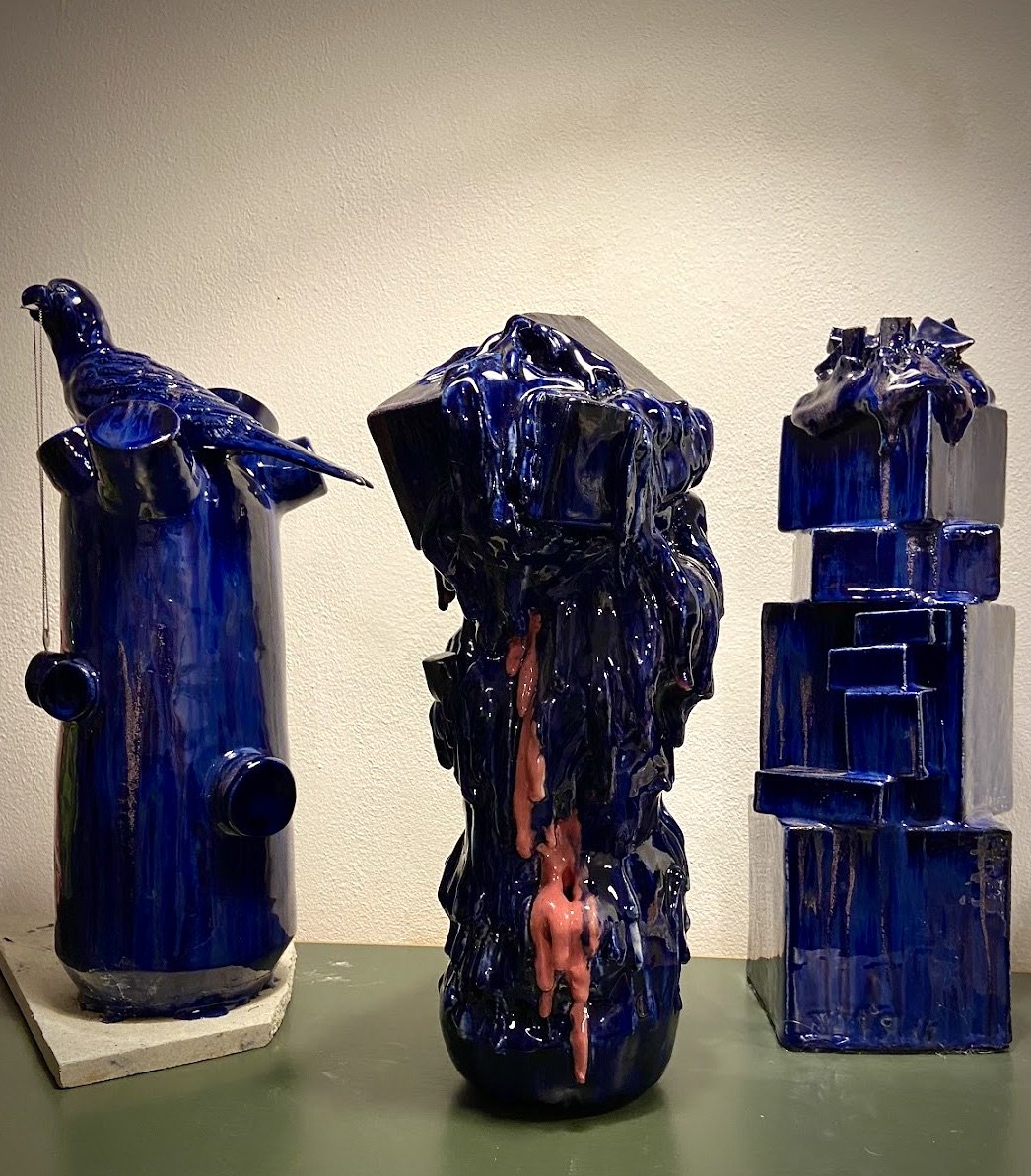
Glazed ceramics, 2026
A Protective Gesture
Transformation, cycles, and the phases of life are recurring themes in Winther’s work. As a child, she studied salamanders and frogs by the marsh in Juelsminde. The female salamander carefully folds aquatic plant leaves around each egg and seals them with secretions, a protective gesture against predators, until life breaks forth fourteen days later.
On the worktable, Winther is finishing a sculpture of a cuckoo. “It lays its eggs in other birds’ nests,” she says with radiant enthusiasm and continues, “It is inspired by the film One Flew Over the Cuckoo’s Nest”, as she equips the abstract blue parrot’s beak with a hanging key on a chain.
I am drawn into the grand narratives she unfolds; a human being who dares to share both fractures and abandonment, and who despite detours, creates contemporary art of the highest quality and burning relevance.
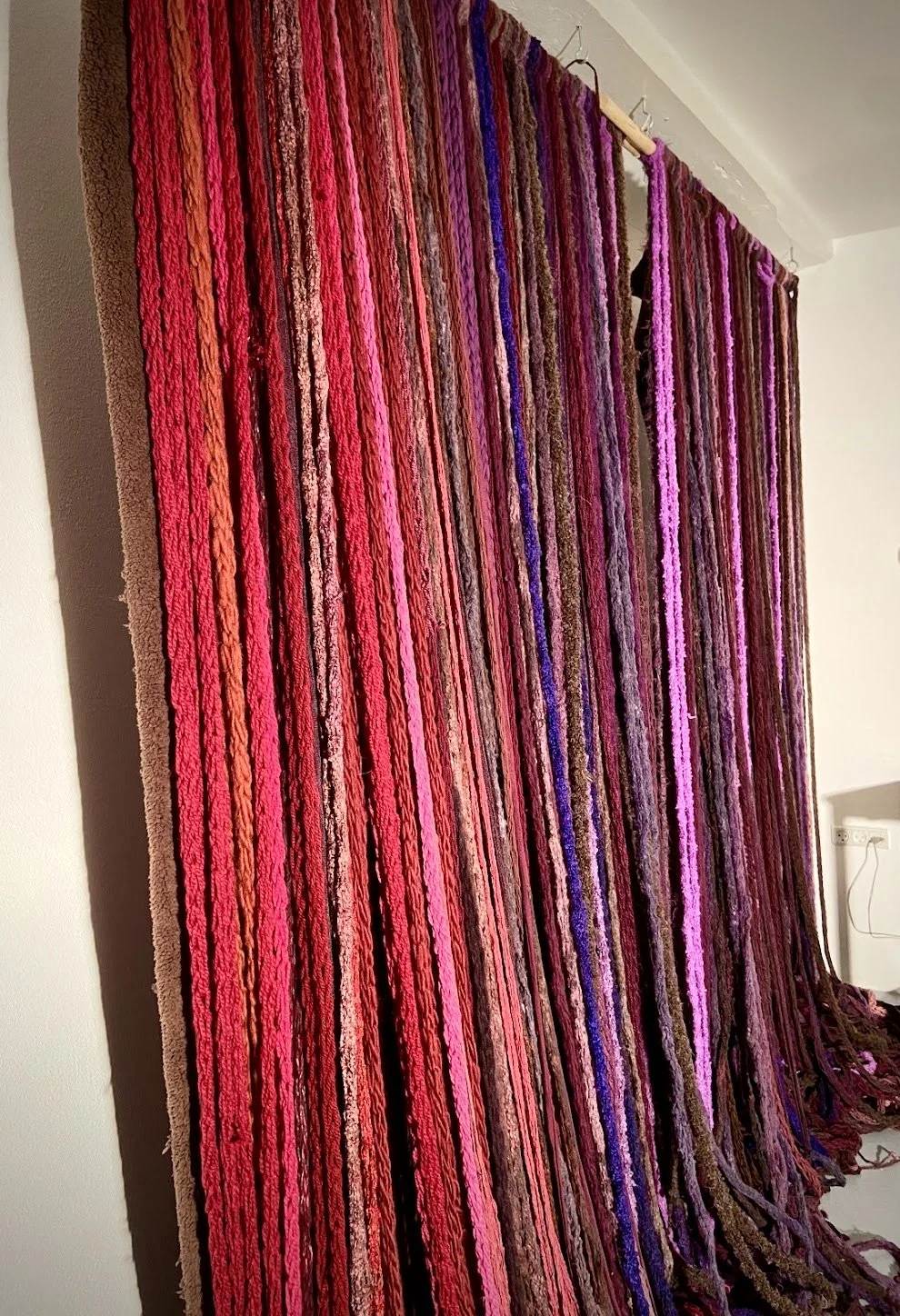
Ingrid, finger knitted yarn, 2026
Yarn Is Thicker Than Blood
Over coffee, my gaze keeps returning to Ingrid. A monumental finger-knitted work, suspended in long, bodily strands from ceiling to floor, ending in a jumble of patterns, entanglements, and evolutions. Winther created the piece while her mother was terminally ill, sitting by her side for an entire year. “The gross measurement comes to ten kilometers, but it has shrunk in the process”, she notes. “I’ve measured it”.
We let our breathing sink deep into our lungs and sit quietly with Ingrid as time seems to stand still. The artist has captured both time and void in a gigantic portrait of her mother. Yarn is thicker than blood, I'm starting to think.

Detail of Ingrid, finger knitted yarn, 2026
There Was a Nest
As a kid she lived in “a constant debt of gratitude, like many children from orphanages,” Winther explains to me. Grateful that there was a nest to land in. And I am grateful that she insists on giving this experience form. What would we do without artists like Winther, an artist who not only masters the craft, but insists on the difficult conversations and shares them with an energy carried by an unusually reflective, empathetic way of being in the world?
“There's always a twenty percent surprise when I open the kiln”, she says as we talk about the process. And she is right. Winther herself is a surprise at first glance, a quiet presence, but beneath the shell a force of nature, an artist brimming with creative power, narrative strength, and raw vulnerability.
Around every corner I encounter a new work that demands immersion, and I regret that time has passed so quickly. As I prepare to leave the brick villa, I am a little happier, a little more enriched, awakened in the winter cold.
“The body remembers,” she assures me.