
“I go crazy every other week”
- Maria Engholm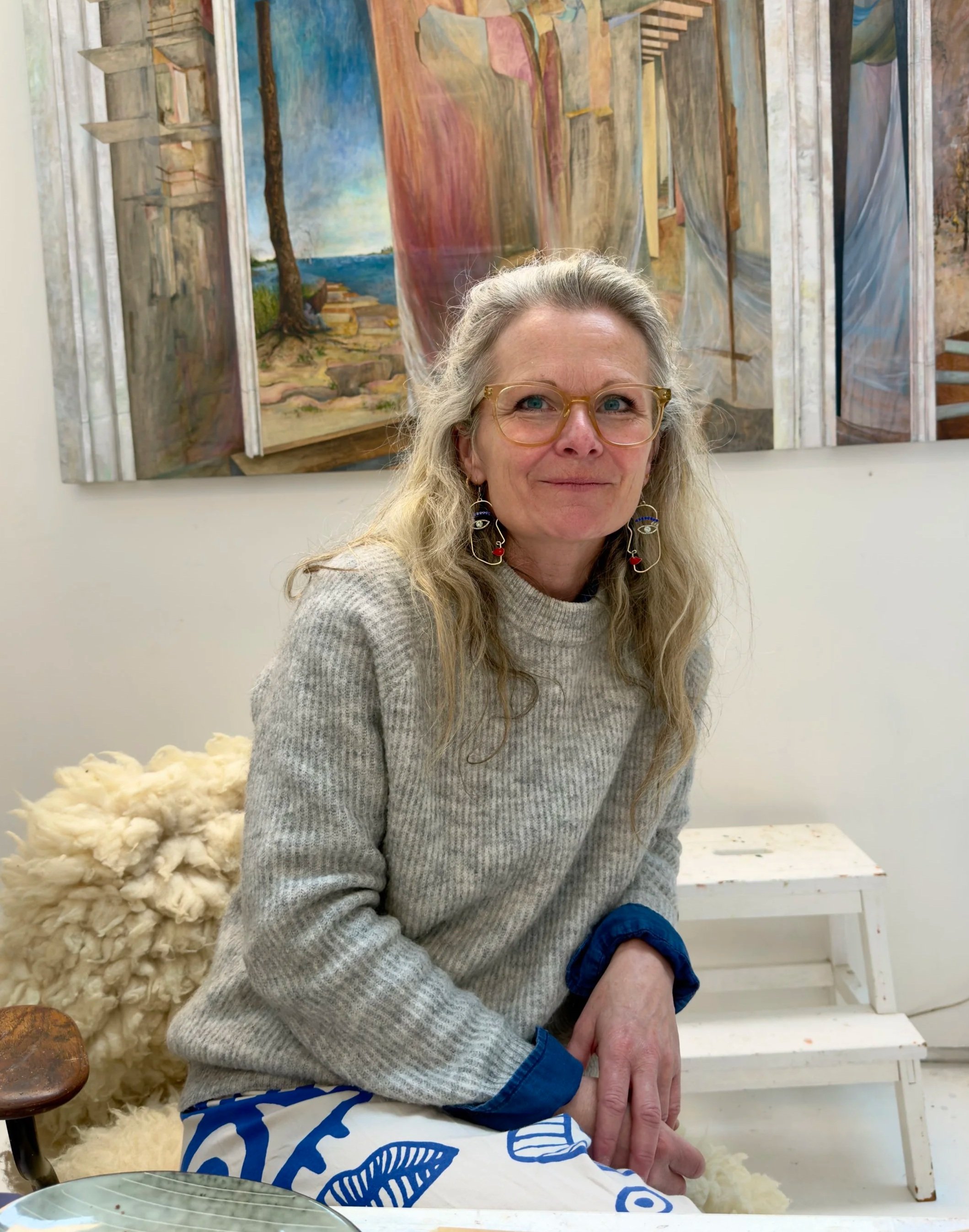
A technical virtuoso. Meet the visual artist Maria Engholm, and let yourself be encircled by unique utopian dream worlds, where the tree rings dictate the direction.
The Magic Energy of Night
You don't have to stay long in the presence of Engholm’s works before being drawn into a universe of minutely detailed landscapes: cities ablaze, figures engulfed by the forces of nature, architectural elements rendered with meticulous precision, yet always accompanied by darkness as a subtle, persistent companion. “I work best from 11 p.m.”, she explains, and in that moment the studio’s grand skylight seems almost superfluous; here it is the moon, the mystique of night, and the intimate, near-symbiotic dance between artist and work that reign.
Engholm grew up in Snoghoej, near Fredericia, spending countless hours by the sea, on boats, along coastlines, immersed in saltwater. Her educational path, first as a primary school teacher and later within design, from textiles to furniture and space, has left a distinct imprint on her aesthetic expression, whether it unfolds on canvas or on finely sanded pieces of wood shaped into oval, almost skipping-stone forms.
The studio itself appears as an extension of this practice: furnishings crafted by the artist, a wooden stool with tin shoes, a coffee table composed in balanced patterns, a chair of remarkable ergonomic grace. “Yes, please”, my back seems to say as I test it. “I have a thing for oak”, the artist interjects politely. She is fascinated by the wood’s strength, its minimal shrinkage, its longevity; by the leathery leaves, dark green above and paler beneath; and by the tree’s capacity to endure for millennia as a silent witness to humanity’s often catastrophic treatment of the planet.
It therefore seems almost inevitable that Engholm has cast her love on wood as a material. The tree rings in the cross-section bear witness to the life and condition of the tree, with a particular sensitivity to those years when growth deviates, when something special has taken place.
"I have moved in several paths of life", the visual artist Maria Engholm confides, shortly after I have navigated through locked gates with coded entries and the discreet yet omnipresent gaze of surveillance cameras, and found my way to the building, guided by her calm voice on the phone. Once seated and welcomed, she unfolds her long and dedicated practice: thoroughly, reflectively, and with a rare generosity.
artSIStra interview // Henriette Hellstern // Apr 18. 2026 // Vaerloese // Denmark
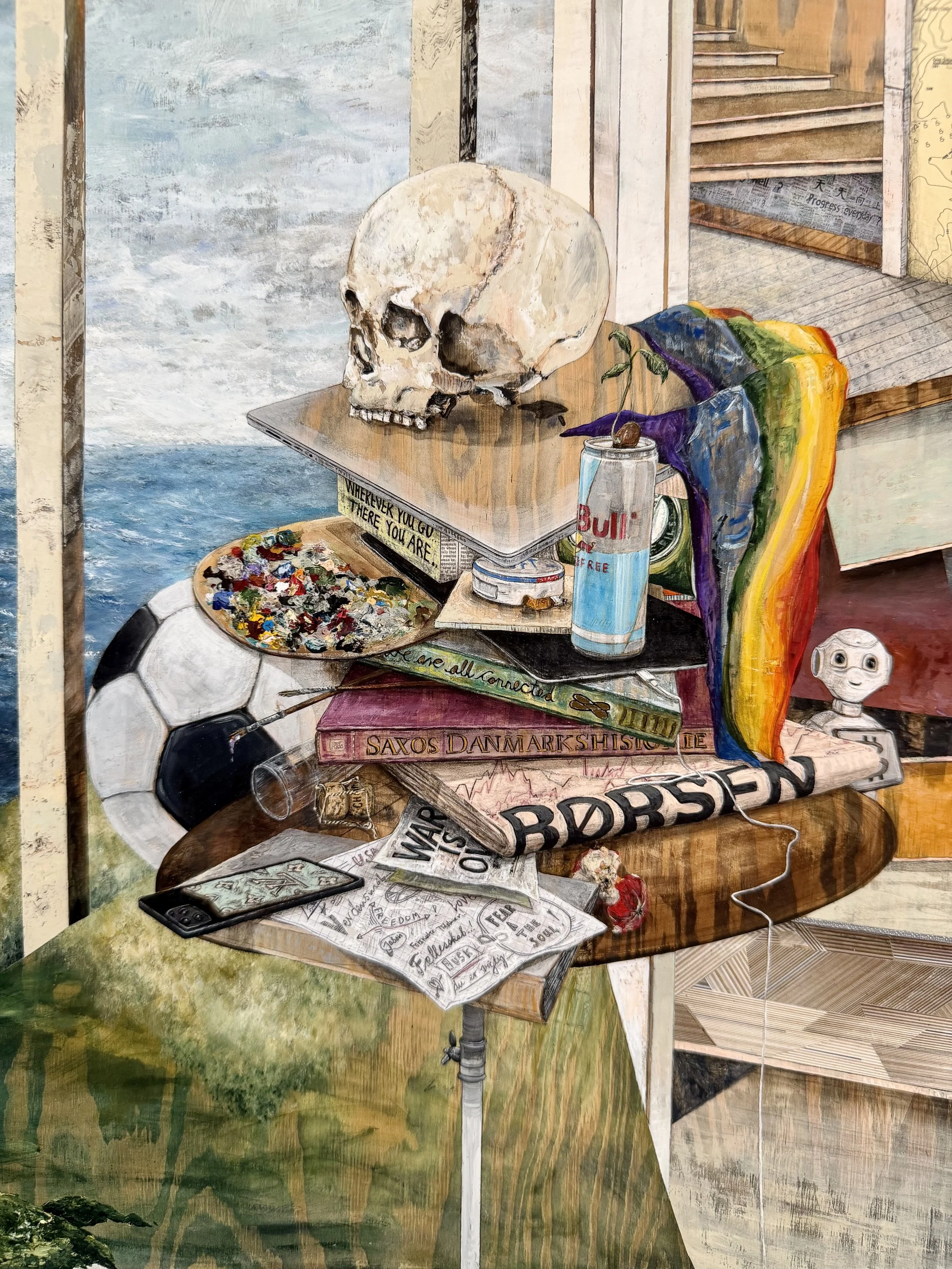
Detail of commissioned artwork for Oeregaard GymnasiumSomewhere Between Routine and Impulse
A particular energy permeates her work: a charged balance between routine and predictability on one side, and a defiant, almost hellish impulse that must find its outlet in art on the other. This ongoing tightrope walk has proven decisive, both in overcoming a period of illness with cancer and in the effort to find footing in the face of mortality’s reality. Perhaps it is precisely for this reason that openings, passages, and doors almost always appear in her works: a constant motion, an insistence on being en route.
“I work a great deal with connections and transformations”, she says, and it is evident that art has served both as anchor and as voice for an artist who has experienced life in its many facets, along multiple trajectories, and continues to move steadily forward. Weeks where works are created in the moonlight to the tunes of everything from Charles Aznavour to Slipknot are replaced by weeks characterized by planning, applications and dreams. As she puts it: “I go crazy every other week.”
Flower Seeds as Bribery
A kinship between material and human beings emerges. On the surface, one encounters a technical virtuoso; beneath this, a resolute character who battles the injustices of existence. She appears to observe the world from her own position, formed, grateful, and still in motion.
Rooted in a socially activist practice, including her participation in the artist collective Bureau Detours, where various experiments culminated, e.g. a trailer functioning as a mobile cinema and gallery, the artist has built an experiential ballast she herself describes as essential. Among these projects was the one in which she rented a parking space in Vesterbro and established a temporary garden, bribing the police with flower seeds so she remained seated in her folding chair until the parking ticket expired.
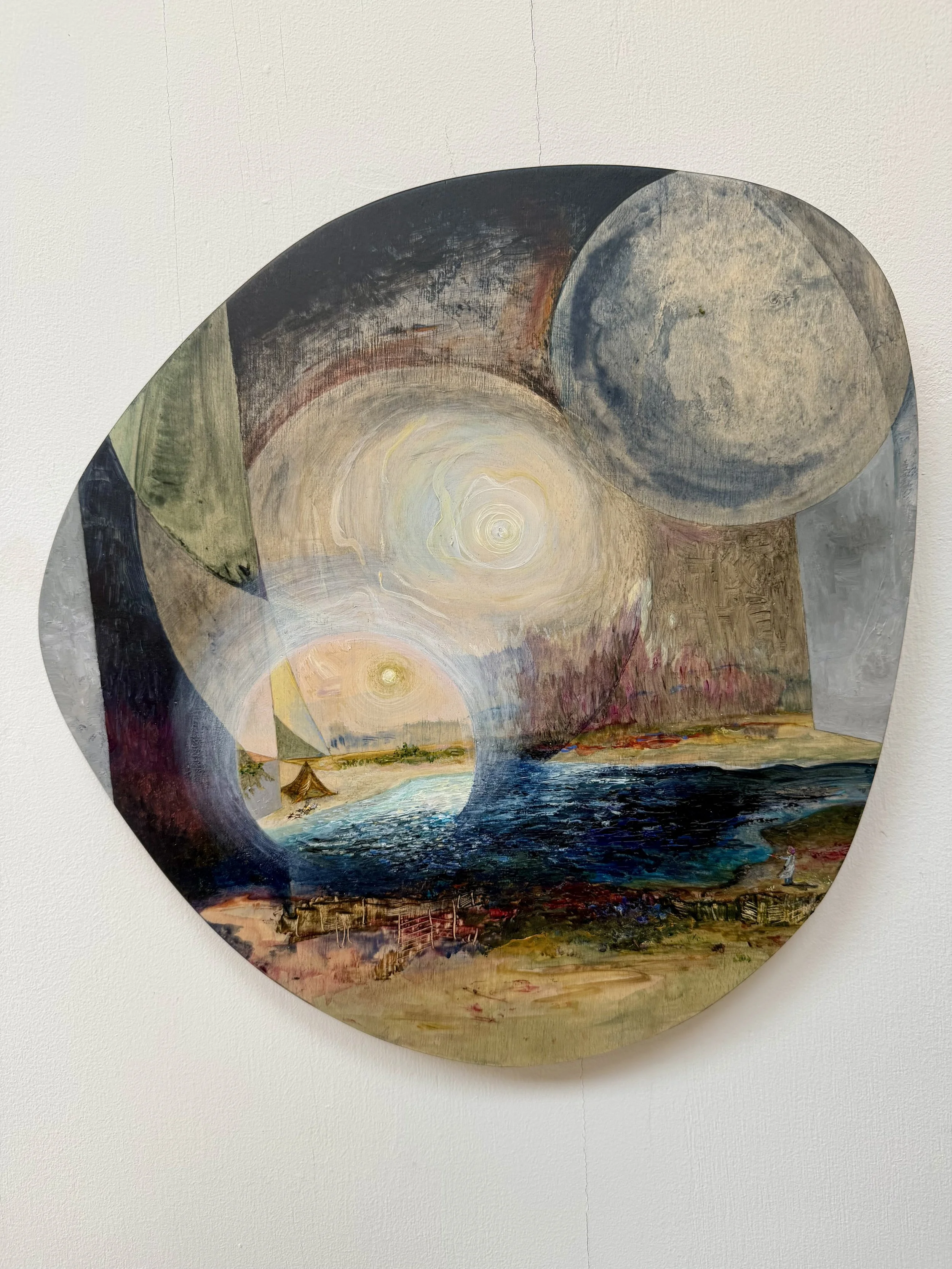
Artwork by Maria EngholmEntrances and Rings of Growth
My gaze lingers on a work composed of upright and fallen domino-like forms, or are they doors? Created during the pandemic, the piece captures with acute sensitivity the feeling of isolation: being a single piece in a larger puzzle, enveloped in solitude, cut off. At the same time, it reads as a reflection on the many portals artists must pass through, some closed, some open, others requiring one to seize the key.
It therefore seems almost inevitable that Engholm has cast her love on wood as a material. The tree rings in the cross-section bear witness to the life and condition of the tree, with a particular sensitivity to those years when growth deviates, when something special has taken place. At the same time, she demonstrates a consistent respect for found objects: recycling, elevating the discarded into aesthetic objects through sanding, varnishing, and the application of thin layers of paint with the finest brushes, mastered to perfection.
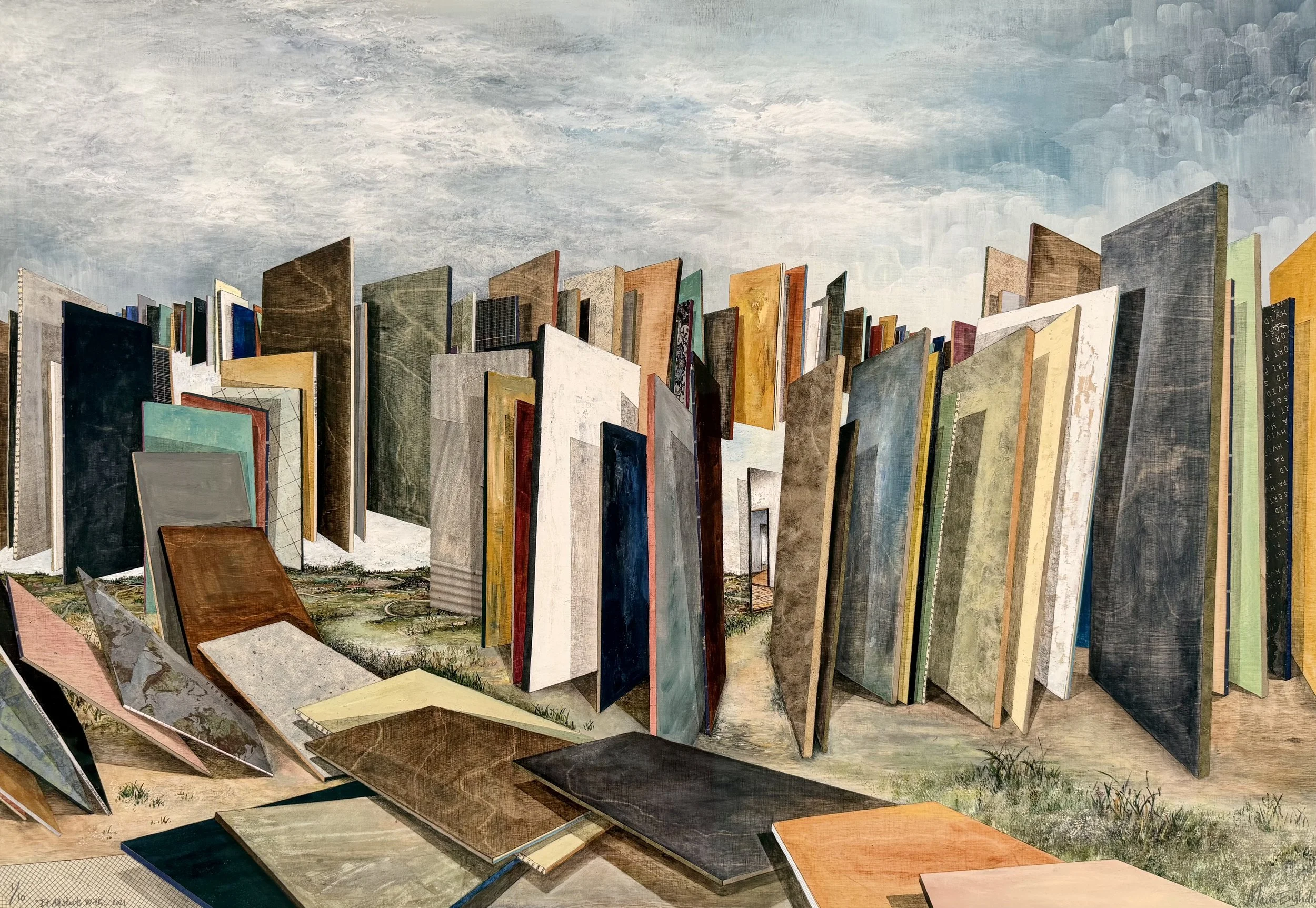
Artwork by Maria Engholm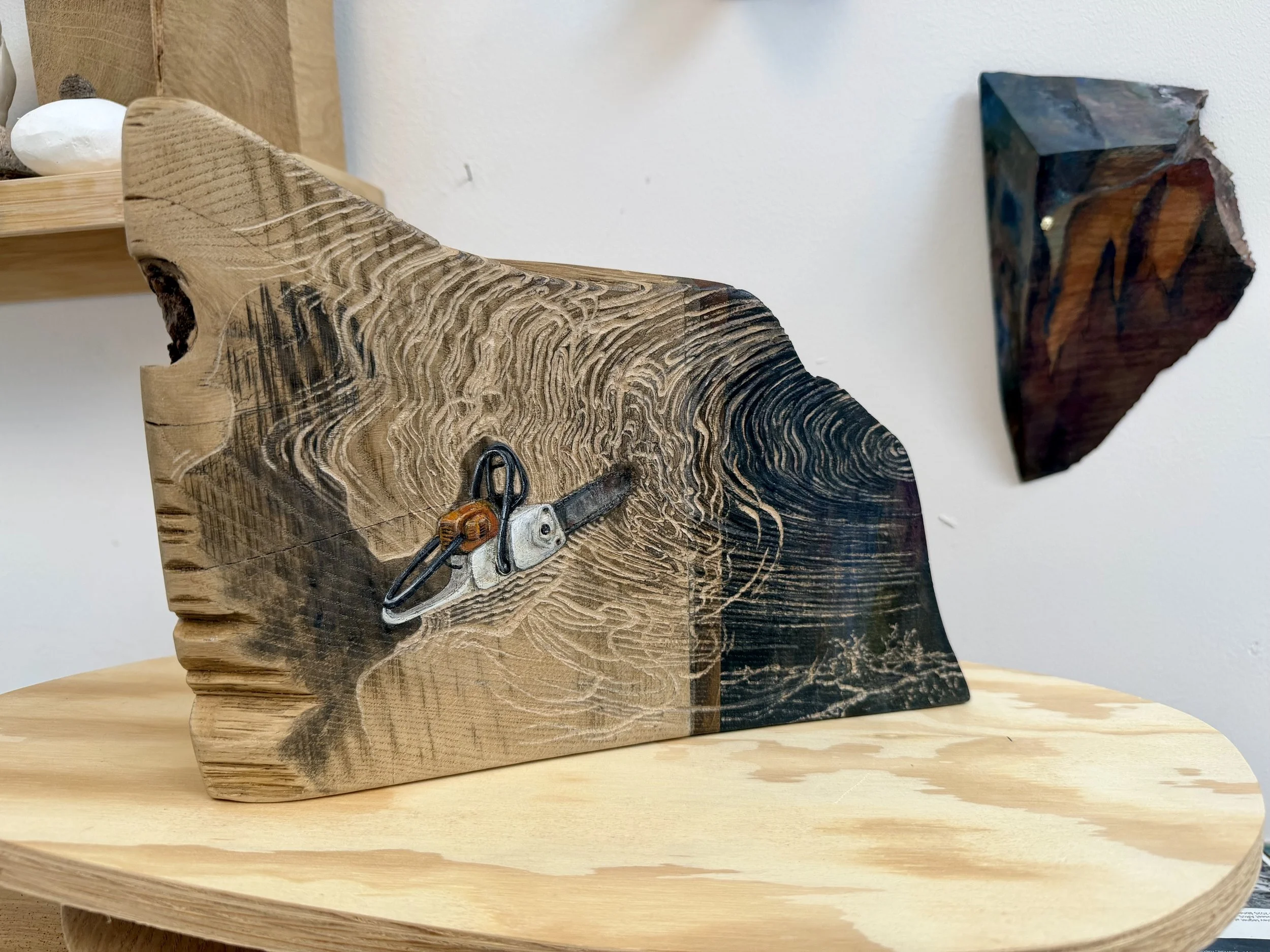
Artwork by Maria EngholmTransitions, Appeals, and Awakening
Yet the artist now stands at the threshold of a new phase. She seeks openness and broader gestural expression. “I’ve returned to the canvas, and I don’t know what will happen”, she says with a note of wonder. These transitional phases seem necessary, beginnings of something new, borne by the courage, will, and strength not to succumb to the familiar.
Finally, my gaze is caught by a small work in the corner of the studio: a triangular wooden block painted with a silhouette wielding a chainsaw, cutting circular patterns. As if the felled tree itself were articulating its pain, a silent yet insistent appeal: see what you are doing to nature, see what you are doing to me. Here is an artist who gives nature a voice; today it whispers, but tomorrow it may well raise its cry.
Hours after our parting, a message arrives: “…and suddenly the light came, now I must begin”.