
“I add some glitter and it’s fantastic”
- Tina MenoreAn Ambassador of Serenity. Meet visual artist Tina Menore and let glitter, pastel, and party fill your body.
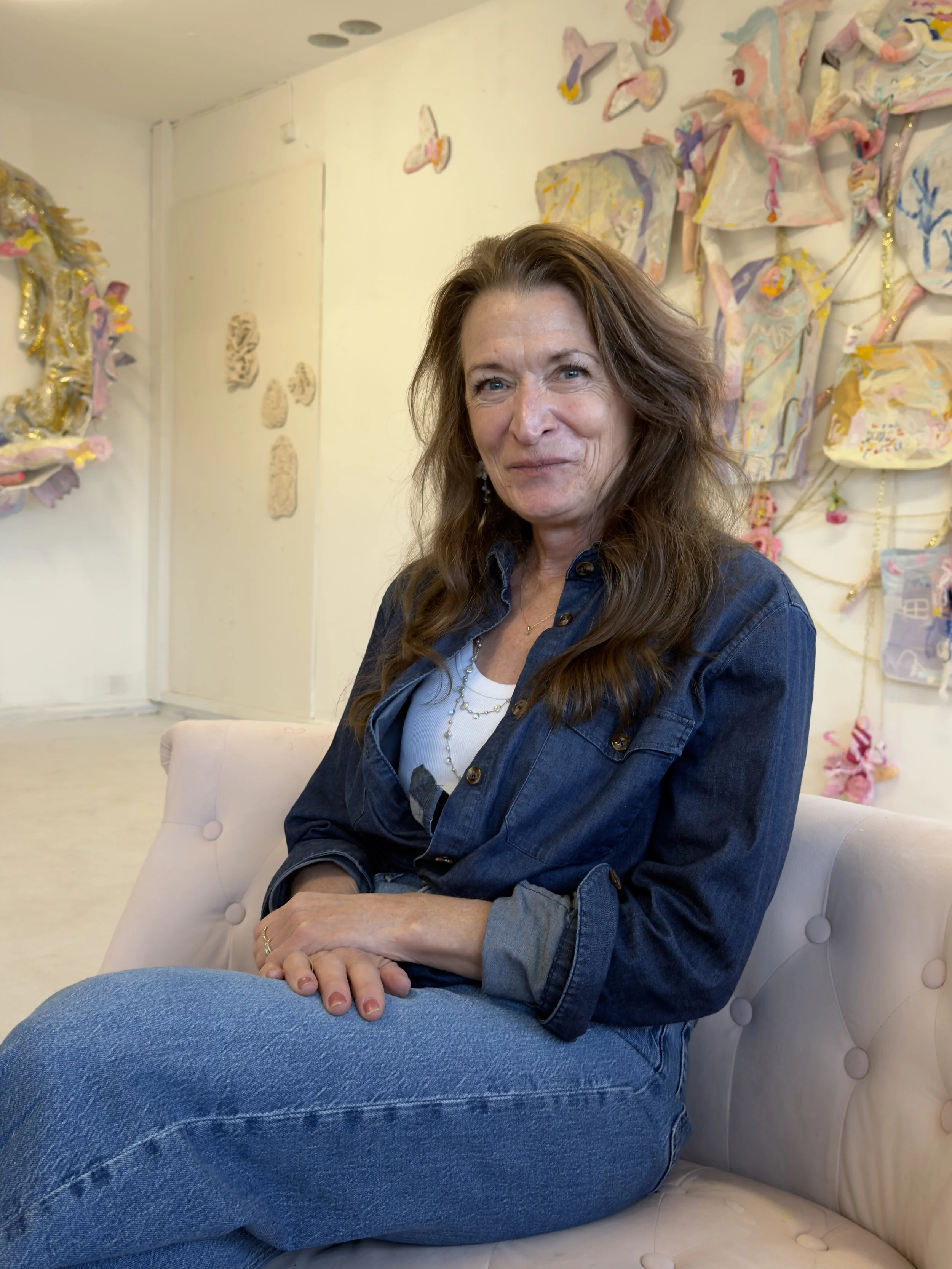
artSIStra interview // Henriette Hellstern // Apr. 18. 2026 // Vaerloese // Denmark
It is a universe perhaps best described as a kind of impressionistic excursion to Disneyland, a mélange of the playful, the sensuous, and the remembered, with an all-access pass for everything and candy floss in the corner of your mouth.
“Welcome,” Tina Menore exclaims, in high spirits with purple glitter on her forehead, as I step into what feels most like a dance floor, surrounded by one exuberant guest after another, rendered in papier-mâché and clay, coated in carefully balanced hues and disco tones.
Menore’s studio, located just outside Copenhagen, appears as a sensory supersaturation: a saline injection of rare potency, a happiness pill and a dopamine fix in one and the same room. We agree to conduct the interview in Danglish as it begins.
The Continuum as Ideal
An especially in form Menore outlines her artistic expression: “I started with a love of glitter, then moved to 3D frames, and eventually it became a deep fascination with spatial objects,” the visual artist explains, continuing, “the three-dimensional became an invitation to the audience, a portal into a particular physical world”.
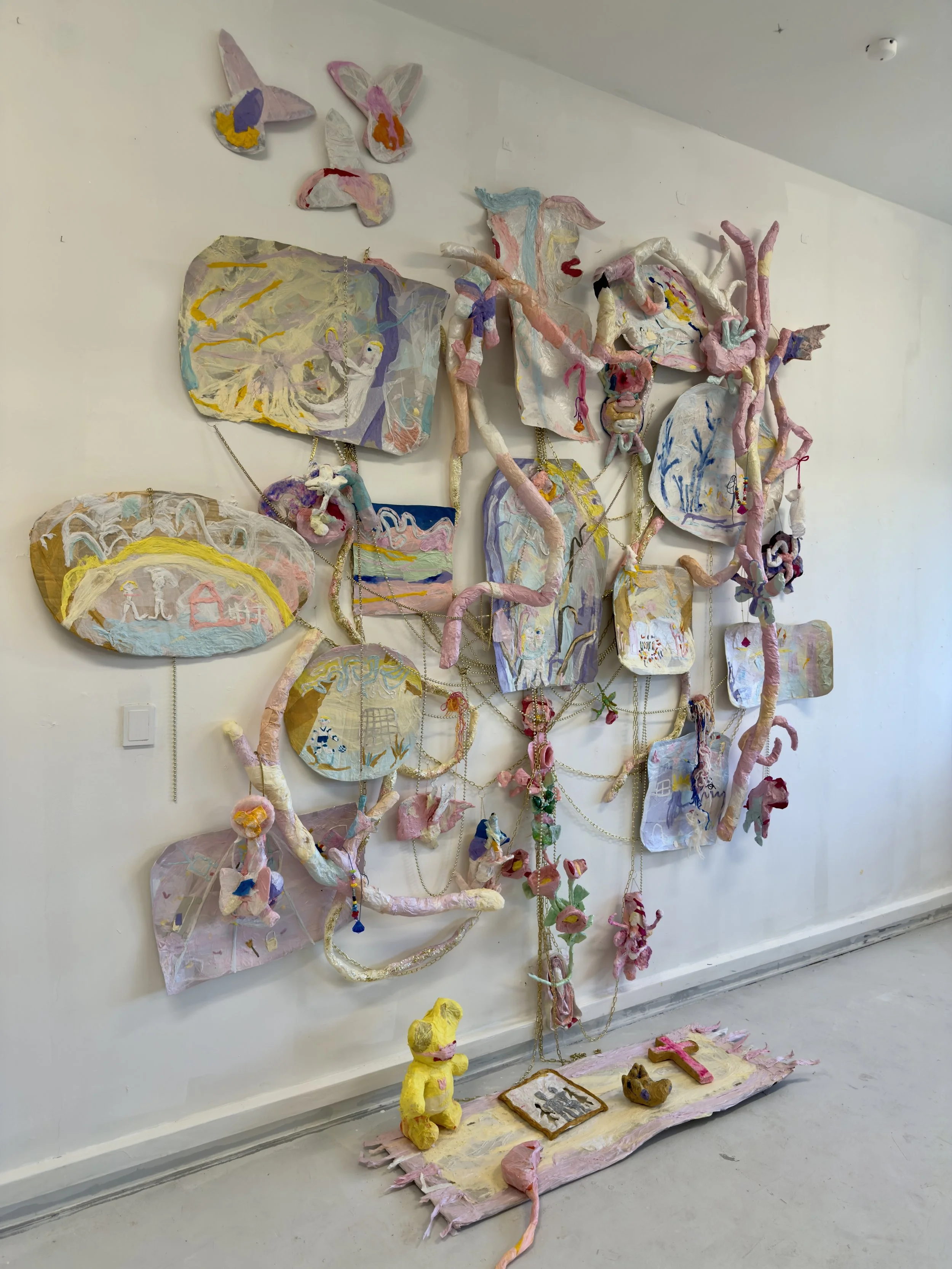
At the center of the studio hangs, perhaps not coincidentally, Family Tree, an installation composed of life’s small yet meaningful moments. We agree that the good life seems to reside in the middle, in the continuum, in an existence without dramatic fluctuations, as a possible ideal. The artist has created small tableaus and sculptural objects, each representing a moment of such weight that it has earned its place within this tree. Chains and beads wind across the scenes like insistent strands of DNA. It is a universe perhaps best described as a kind of impressionistic excursion to Disneyland, a mélange of the playful, the sensuous, and the remembered, with an all-access pass for everything and candy floss in the corner of your mouth.
Family Tree by Tina Menore, 2026
From San Francisco to Copenhagen
When Menore places a papier-mâché cross on the floor, flanked by a rat and a clenched fist, it becomes clear that she is an artist who has experienced life on both sides of this sought-after midpoint, and emerged strengthened.
Shaped by a youth in San Francisco’s Mission District in the 1970s and 1980s, a period marked by profound cultural shifts, during which the city functioned as a global hub for human rights struggles and artistic subcultures, she carried a willpower and determination that transcended financial limitations.
Love brought her to Denmark. “What year was that?” I ask curiously. “One moment, I just need to take off my ring, but don’t tell my husband,” she laughs, consulting her wedding ring as a kind of archive. “It was 1988,” the ring informs us. There is something both liberating and gently comic in this gesture, that the pivotal year of a life-altering transition is not immediately accessible in memory. One thing, however, is clear: Menore is on a mission, we should worry less about detail and be more present.
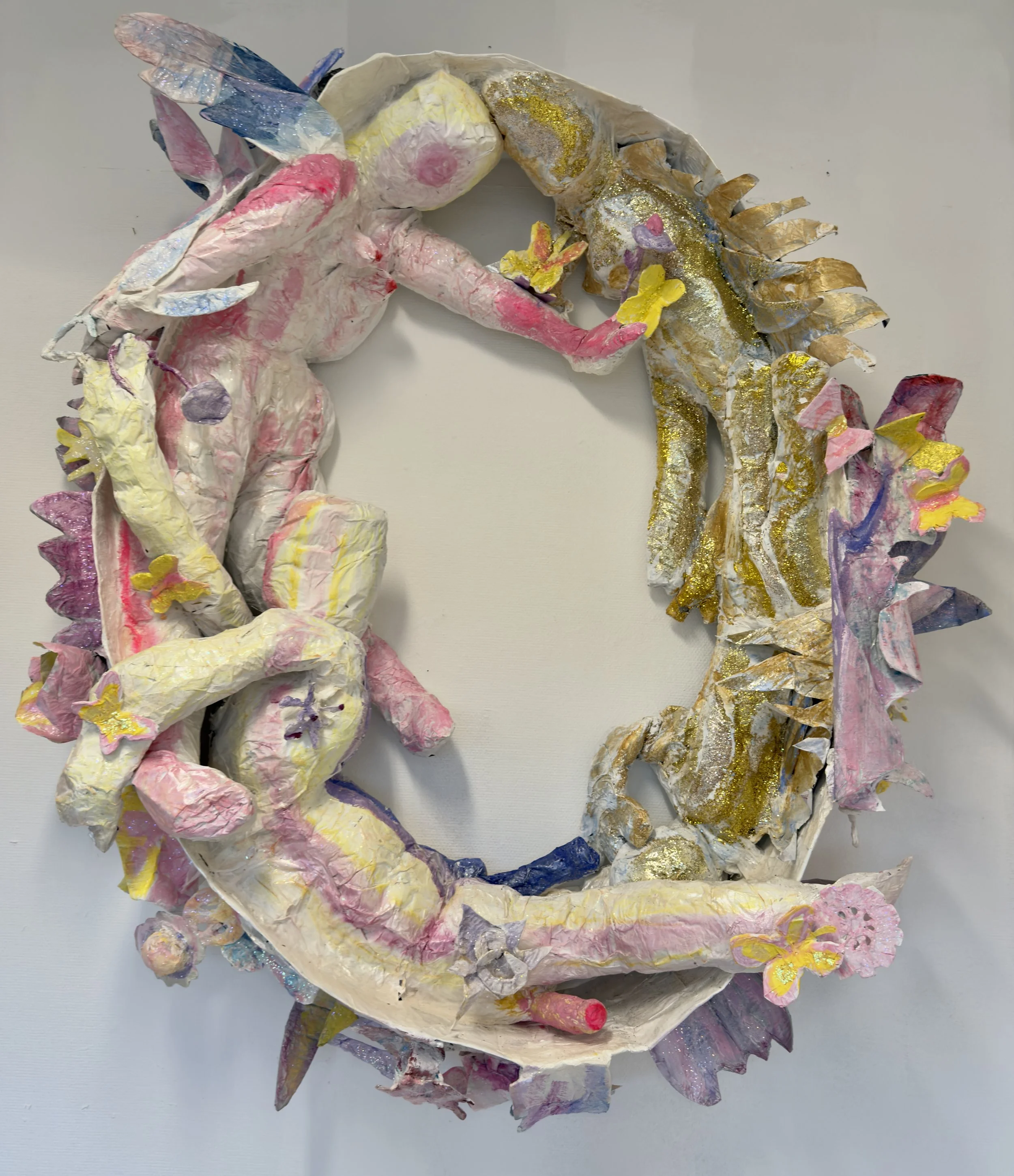
Sex Angels and Butterflies by Tina Menore, 2026
Glitter is Key
Her biographical trajectory forms a narrative of movement and transformation: raised in the Catholic faith, leaving home early, becoming a mother at a young age, and now a grandmother of four. And now her artistic practice has fully unfolded over the past fifteen years, with studies at the University of Copenhagen and later at Spektrum, and a sustained exploration of drawing, painting, sculpture, and installation.
Her expression remains consistently distinctive, a kind of aesthetic symbiosis in which celebration, faith, the body, and the energy of the dance floor coexist. “When I make an angel, it can look like crap”, she says with a smile, “but then I add some glitter and it’s fantastic”. We laugh with relief as we observe the work Sex Angels and Butterflies, and within that laughter lies an acknowledgment of the immediacy of the material and its transformative potential. One moment the work evokes a human spiral dance, a whirlwind, the next, a kind of secret portal with Shangri-La awaiting on the other side. “There is love for everyone,” Menore elaborates.
Dance on Prescription
One is tempted to imagine that if Menore were a doctor, she would prescribe dance on prescription. This thought accompanies me as we immerse ourselves in an altar she is currently working on. On the baptismal font rests a hand, covered in gold glitter of course. “It’s my father’s hand,” she clarifies. “My sister and I always held his hand during Sunday mass and played a finger game to pass the time.” Play is a recurring motif, a persistent presence.
As we symbolically dip our heads into the baptismal font and contemplate new artist names, two angel-like forms hover above us. “It should be made of marble,” I insist, as we imagine, to our mutual delight, a monumental altar created by Menore. That church would not remain empty for long, I am convinced. It would fill up quickly, accompanied by the tunes of Madonna's Confessions on a Dance Floor, which would of course be playing on repeat in the sacred halls of Menore.
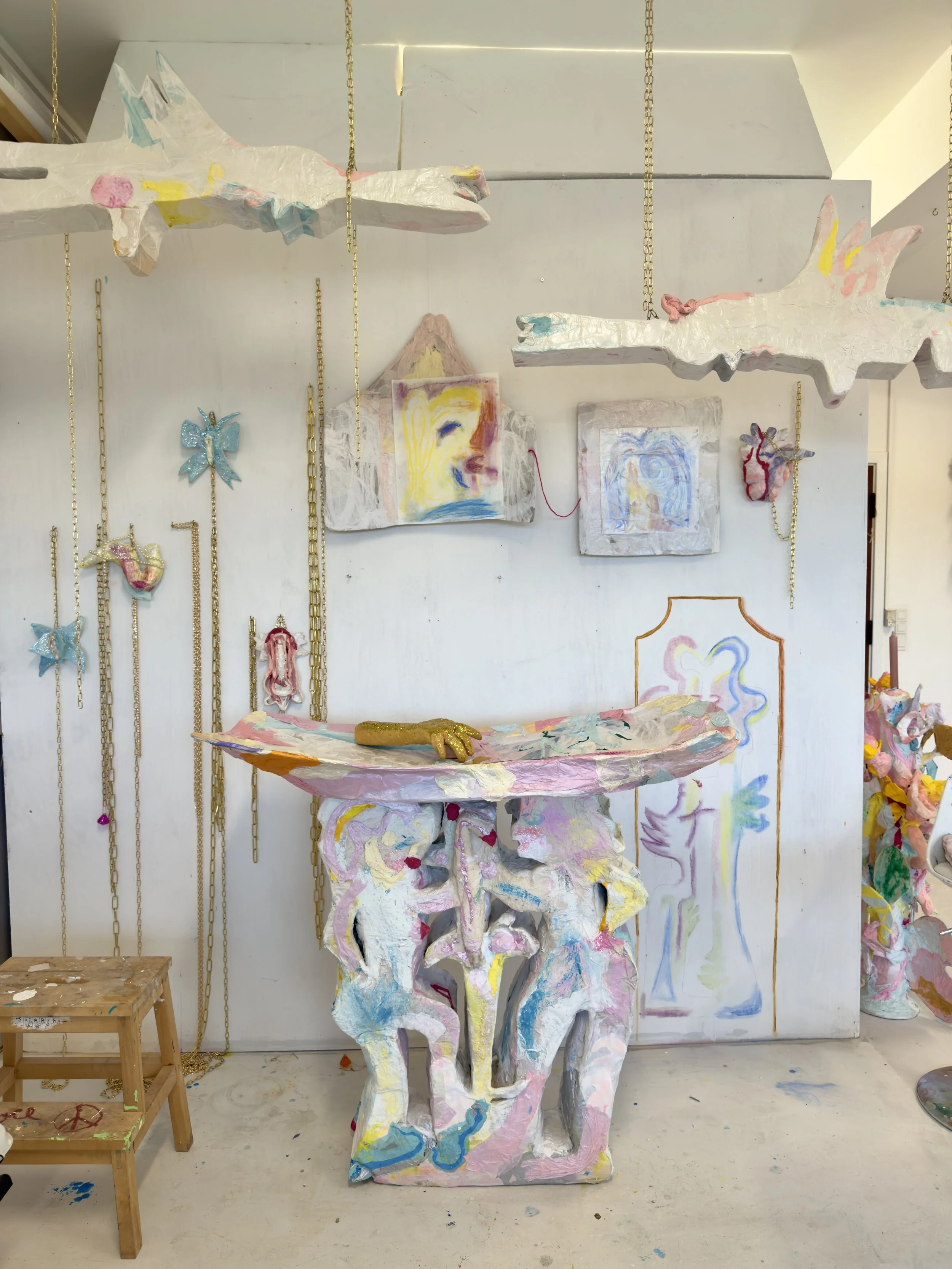
Work in progress alter, by Tina Menore, 2026
Long Live Freedom from Worries
“I want more happiness, power to love and peace,” she says in a way that compels acceptance, repeating her insistence: “We need to worry less.” Behind the statement lies a life experience shaped by struggle, a sustained effort to establish a foothold for herself and her children, as well as acquaintance with the sometimes reserved Danish response to foreign things.
“I’m received better in the art world than in the local community,” she notes. “I have an accent.” An accent I personally worship, yet her remark evokes a certain embarrassment at cultural mediocrity, but also an appreciation that she has not been defeated by resistance. The conversation about migration seems inevitable, particularly in light of a United States marked by political unrest, a quiet melancholy can be sensed within her.
A Freedom Fight for the Middle Way
My attention is drawn to the work I wasn’t expecting that: a headless female figure in an embracing posture. “She protects herself while also appearing strong, somewhat like the Virgin Mary,” the artist describes. Faith is constantly present in her practice, yet it is translated into a visual abundance of magical reliefs, monumental candlesticks, rainbows, and explosive colors. Beneath this lies a simple, almost universal realization: we are different, yet we seek the same, the good life, a life without suffering.
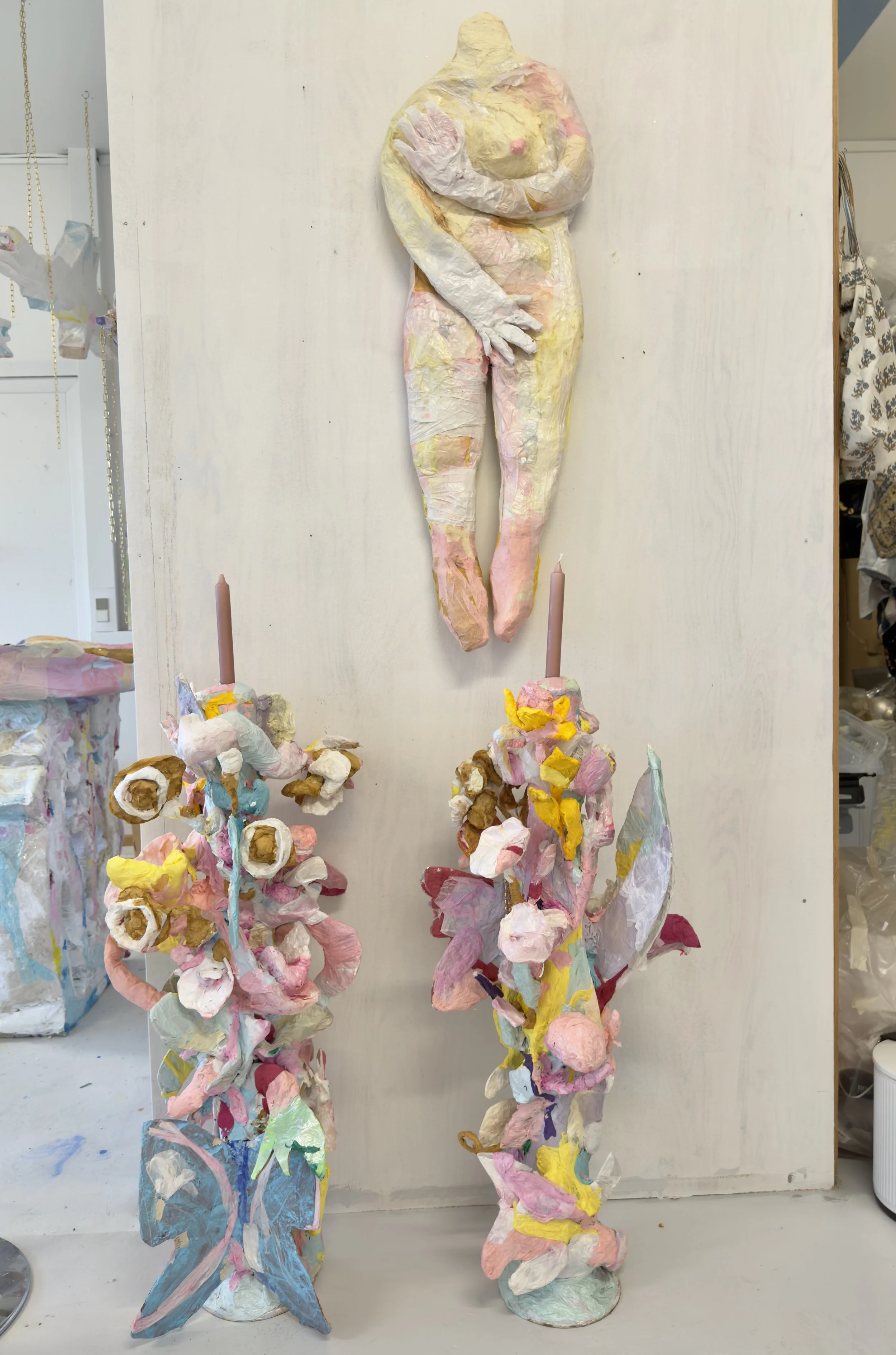
Candlesticks and Virgin Mary in Tina Menore Studio, 2026
It is difficult not to feel a sense of gratitude that Menore insists on reminding us that life is also a celebration, while maintaining that our rights are not given but earned. In this sense, she appears as a kind of freedom fighter, camouflaged in glitter. One might be tempted to call her the Queen of Glitter, the kingdom is undeniably richer for her presence.